显示标签为“Beijing Evening Tour”的博文。显示所有博文

2013年8月29日星期四

Pilgrims flock to 'longevity county'


For the past six months, Zhou Xuezhong has been living in Bama County in south China's Guangxi Zhuang Autonomous Region, a place thousands of kilometers from his home in Beijing.
It's the second year that the retired senior citizen has chosen to live temporarily in this "longevity county," which boasts a high number of centenarians.
The 73-year-old Zhou, who has been struggling with asthma and coronary disease for years, said he believes the good environment in Bama can help him battle his diseases, and he plans to return to the county annually.
Located in northwestern Guangxi, Bama counts many long-living elderly among its population of 240,000.
Official statistics show that there are nearly 31 centenarians for every 100,000 people in Bama. In 2012, Bama reported 81 centenarians, giving it one of the highest rates of centenarians in the world.
The natural conditions in Bama are widely believed to have contributed to local people's good health. Scientific tests show that the amount of negative oxygen ion in the air in remote Bama is far above that of many other places in China, and many believe this leads residents to feel energetic and comfortable.
The stories of Bama's "living legends" have spread across the country and enticed an increasing number of people from other provinces hoping to find the elixir to an enviable long life.
Earlier this month, various media outlets in China reported that many longevity pilgrims "crawl like dogs" and even drink urine in Bama, believing such practices can help keep illness at bay.
As more newcomers swarm to the county, a health preservation industry has
gradually sprung up in Bama, partly thanks to promotion by the local government and the inflow of capital. In recent years, its tourism industry has soared due to the promotion of health preservation.
"We are trying to make Bama an international resort for health and recreation," said Feng Haifeng, secretary of the county committee of the Communist Party of China in Bama.
In 2012, the county received more than 2 million domestic and foreign tourists, a year-on-year increase of 23.3 percent. The revenue it generated stood at around 2 billion yuan (about 327 million U.S. dollars), accounting for 48.6 percent of
Guangxi Zhuang Autonomous Region
Bama's annual gross domestic product.
In the first five months of this year, Bama has already received over 1million visitors, generating more than 927 million yuan in tourism revenue.
The reputation of the remote county is so widespread that it has even attracted a number of people who travel from far away to live in Bama for an extended stay.
This group is nicknamed "houniaoren," or "migratory people," with lives like those of migratory birds -- flying south in winter and staying in Bama for several months.
Chen Jinchao, head of the Guangxi Bama Longevity Research Institute, said the number of migratory people flocking to Bama has been on the rise in recent years.
"Last year, around 10,000 such tourists spent their Spring Festival, or the Chinese New Year, in Bama," he said.
Government statistics show that in 2012 alone about 180,000 migratory people visited Bama.
Most of the migratory people go to Bama for health recovery or even medical treatment, as they believe living conditions there can facilitate recovery.
Zhu Zhijun, a migratory person himself, said there are thousands of people like him living in Bama, many of whom have been diagnosed with cancer or tumors.
While the incoming tourists have contributed to the growing tourism revenue, they have also raised concerns.
Although no scientific evidence has proven that the natural environment in Bama is effective in curing illness, the county's reputation for longevity has stirred blind faith among many who regard it as a place offering the recipe for long life.
"Some people believe that once they are in Bama, all manner of diseases will be miraculously cured, without taking any medication," Chen said.
For instance, some patients resort to eating the Huoma, a local vegetable believed to guarantee a long life, on a daily basis, just because they believe that the Huoma will "keep the doctors away."
Others are obsessed with Bama's water. They even name it "divine water," thinking that it has amazing medical effects, while in fact the unfiltered water could contain excessive bacteria and cause diarrhea, Chen said.
He added that some patients insist on swimming in the "divine water," which has led to several drowning cases and forced the local government to put up fences around rivers.
Chen said another consideration is the possibility of disease transmission if more patients come to Bama for medical treatment.
"Although the clean air and water could provide a good environment for the recovery of people with chronic diseases, it is not a hospital," Chen said.
He believes that people obsessed with Bama are following the crowd, and that they should have a better understanding of what health preservation is really about.
"What's really important is for people to build a healthy lifestyle and raise awareness about exercise, rather than blindly searching for a long-life recipe in a longevity county," Chen said.

2013年8月21日星期三

Rongbao Zhai Chinese Painting Workshop


Rongbao Zhai is located in  Liu Lichang West Street with its former name as Dongzhu Zhai. In the 20th year of the reign of Emperor Guangxu in Qing Dynasty (1894), it changed its name into "Rongbao Zhai". It is always a place for people in the circle of painting and calligraphy to gather and communicate from the early period.
Rongbao Zhai is famous for its wood-block watermark printing at home and abroad. Its wood-block watermark printing is made by masters with great talent, which is the reason why any of the current printings can't compete with it. The wood-block watermark printing has a long history in China. In the early 9th year of the Rongbao Zhai can not only print Shijianxiaopin (comment or short essay inscribed on the wood or printed on the paper or silk with great exquisiteness), but also engage in complicated silk painting and monumental long book copy, which are similar to the real ones. Rongbao Zhai's products such as "Poem of Seventy-two Officials" and "Twenty-four Solar Terms Envelope", made by the wood-block watermark printing, was regarded as very outstanding products in Liu Li Chang by Lu Xun and Zheng Zhenduo.
Rongbao Zhai Chinese Painting Workshop
reign of Xiantong Emperor in Tang Dynasty (A.D. 868), a person named Wang Jie printed illustrations of Diamond Sutra with this technique and these illustrations remain until today. From the Tang Dynasty, most books are accompanied by illustrations and the process printing is available in the 16th century. In recent decades, with new improvements and achievements made on the basis of the traditional techniques, at present
At present, Rongbao Zhai has a large collection of authentic works and reproduced ones made with wood-block watermark printing techniques of ancient and modern painters and calligraphers. It also provides four treasures of the study (brush, ink, paper and ink stone) as well as services like mounting, processing and repairing, which brings great convenience for painters and calligraphers. Rongbao Zhai has made great achievements in booming the artistic market of painting and calligraphy and promoting international cultural exchange.

2013年8月11日星期日

National Art Museum of China

Located on Wusi Street, the National Art Museum of China was established in 1962 to exhibit outstanding works of modern Chinese artists. The gallery has 6,000 square metres of exhibition space, which is divided into 14 exhibition halls currently housing 10,000 pieces, not including folk art. The central part of the gallery, with four floors, has an ancient Chinese pavilion type roof. The
National Art Museum of China
surrounding flat roofs have skylights to allow for natural lighting. The building is decorated with glazed tiles, a traditional Chinese construction material and many of the walls are paved with light yellow ceramic bricks. The designer wanted the building to reflect ceramic art. With the development of a commercial economy, traditional donations from fine artists are now being gradually replaced by sales. The gallery gathers works through a variety of channels which include buying them from national and local exhibitions and offering financial aid to some fine artists who sell their work to the gallery. The research staff at the gallery excels at the development of the study of fine art, and they have published dozens of articles and papers. From 1962 to 1995, the China Art Gallery organized over 1,000 exhibitions covering everything from photography and calligraphy to stamp collections. Some of the shows were co-coordinated with other galleries such as the China Folk Artistic Work Gallery. From 1962 to 1977, the total budget for the gallery was 2.25 million yuan. The average annual budget since 1978 has increased to 560,000 yuan. With profits from the exhibitions, it has the potential to become the nation's finest art gallery.

2013年8月5日星期一

Visit Beijing Shooting Palaestra This Summer


During the Beijing 2008 Olympic and Paralympic Games, the venue will host a total of 10 shooting events. It will also likely be the venue where the first gold medal will be awarded during the Beijing 2008 Olympic Games.
Present at the delivery ceremony were officials from the State General Administration of Sport, the City of Beijing, and Mr. Wang Yifu, head coach of the Chinese national shooting team.
Construction of the venue broke ground on July 13, 2004. The venue, with a total surface area of 45,645 sq m, contains qualification competition halls, a final competition hall, a storehouse, a room for armed police use, a heating and ventilation equipment room, and an electric transformer room.
Visit Beijing Shooting Palaestra This Summer
The qualification competition hall contains 10m, 25m, and 50m target ranges. The final competition hall contains sealed 10m, 25m, and 50m target ranges.
The venue has a total seating capacity for 8,600 spectators, with 2,170 permanent seats and 6,430 removable seats. The qualification competition halls can seat 6.100, and the final competition hall can seat 2,500.
The Beijing Shooting Range Hall was designed to reflect the shape of a hunting bow. This design takes into consideration the origins of the sport of shooting—hunting in the forest. The Shooting Hall's qualification competition halls and the final competition hall are connected by the venue's main entrance, which contributes to the venue's "bow" shape.
Post-Games, the venue will host important international and Chinese shooting competitions and serve as the training base for the Chinese national shooting team and youth training grounds.
Parts of the venue might be used as a national defense teaching facility. Additionally, the venue may be used to promote shooting as a sport to the public and to promote the Olympic spirit.

2013年7月29日星期一

Have a Prince Gong’s Mansion Tour in Beijing City

Gongwangfu (Prince Gong’s Mansion).The mansion on Liuyin Street of Xicheng district was owned by a notoriously
Gongwangfu
corrupt official of the Qing Dynasty, He Shen and his harem of 80 concubines. His only grace lay in his devotion to his wife, Feng Shi, who fell ill after their youngest son died in a battle against rebels. Then her devoted husband hired monks to pray for her health to return, only to find Feng dying of a broken heart. Rumor has it that the house was haunted by the ghosts of the lady as well as many former escorts of He Shen. Late at night, cries of the mother can be heard echoing through the mansion. Even security guards at the tourist spot say female ghosts in white can be seen wandering around the garden.

2013年7月22日星期一

Exploring Art in Lan Bator-Beijing Landscapes


The Monastery-Museum of Choijin Lama is a storehouse of jaw-dropping papier, mache masks and elegant bronze sculptures.
At the heart of Ulan Bator is an art-lover's paradise waiting to be discovered. Chitralekha Basu looks beyond the usual tourist draws and finds a trove of art and culture around the city's central square.
The Monastery-Museum of Choijin Lama
If you stood in front of Sukhbaatar Batbold's now cellophane-wrapped statue in Ulan Bator's central square and drew a circle with a 1-kilometer radius, you would be at the hub of a never-ending exhibition.
Granted, most of Ulan Bator's potential tourist lures - from the Roman-style colonnaded buildings often colored an unlikely shade of dark peach to the multi-tiered pagoda-roofed monasteries - are located right here, but the volume and variety of art on display is truly extraordinary.
The best part of visiting UB's arts hub is that the intense concentration of thangka paintings, appliqu panels showing menacing mythological gods, bejeweled bronze sculptures, quaint hunting tools and masks and costumes worn traditionally by tsam dancers seems inversely proportional to the number of eager connoisseurs.
Miles and miles of art objects stand solemnly in unpeopled galleries. Even the staff, supposed to be looking out for the chance visitor, is hardly ever seen. But don't let that give you ideas. A warren of closed circuit cameras is tracking your moves, just in case you thought of clicking a shot or two on the sly and not paying the fee (see box).
First up on the list is Zanabazar Museum of Fine Arts, by far the most representative collection of Mongolian art, from prehistoric granite sculptures to early 20th-century landscapes by the legendary Mongolian painter B Sharav (1869-1939).

2013年7月3日星期三

Beijing Night Biking Experience


This time my family chose Beijing tour during the holiday. We hope that we will have a nice trip and enjoy the rich culture and the historical sites here.
In order to get some different feelings, we booked the Private Beijing Nightlife Bike Tour through beijinglandscapes. During the two hours we four people enjoy the beautiful night scenery of Tiananmen Square, Houhai Lake and around the Forbidden City. While biking, the English speaking tour guide told us the history, story and the features about each tourist destination. Let me share them with you!

Tiananmen Square is the largest and widest city square in the world and it is the witness of many of important events of the Chinese nation taking place here since last hundred years. There are standing many symbols of Beijing. In the east is the National Museum of China and in the west is the Great Hall of the People. Monument to the People's Heroes stands at the center and Chairman Mao's Memorial Hall is located behind it.
Forbidden City, also known as the Palace Museum, is the palace of 24 emperors of the Ming and Qing dynasties, covering an area of 720,000 square meters. Every day large numbers of tourists come here to experience the "imperial power". However in the evening, it looks a little bit gruesome.

Night Scenery in Houhai Lake

Where I like best is Houhai Lake. The nigh scenery there is really beautiful that when I first saw it I lost in it. There is also a famous bar street there. A small alley along the lake, get together around the sea, no loud music, instead melodious songs and only 80s unique culture. With the characteristics of old Beijing Houhai, the modern city is definitely an alternative melodious. My family and I really like the atmosphere. So tomorrow we will have a cup of drink in Houhai Bar Street to experience Beijing nightlife.
Although the trip only lasted about 2 hours, the tour guide told us a lot about the old Beijing and modern Beijing. Thank you very much for his patience. Tonight we enjoyed a very happy time!

Resource: http://www.beijinglandscapes.com/beijing-travel-blog/night-biking-tour.html

2013年5月22日星期三

Beijing Nightlife Show - Top KTV in Beijing


How and where to spend your night time during your Beijing tour? Now I want to recommend KTV to you. KTV is another important part of Beijing nightlife. It is the gathering place for those who love nightlife. There you can taste kinds of wines as well as dishes, snacks to satisfy your stomach while relaxing by listening to Chinese and other music from other countries. As well it is a nice place for you to sing songs. Some representative KTV listed below.


Party World


As one of the biggest KTV centers in Beijing, Party World features magnificent decoration and high level of service. It is equipped with high quality stereo equipment whose sound effect is splendid. There are Chinese and English songs you can choose. In addition, this KTV offers delicious buffet dinner and beverage free.
There is another benefit that you are allowed to bring your own food if you do not like Chinese food. 

Melody KTV

Located in Chaoyang District, Melody KTV has changed the image of traditional KTV impressed on people. It is a safe, healthy, happy and fashion place where customers can feel the beautiful melody. There you can fully relax yourself via watching, listening, singing, even tasting yummy dishes. Wide option of songs you can choose such as Chinese, English and Japanese. 

Candy KTV

As a 24-hour service Discount-style KTV, Candy KTV features various sizes of rooms to satisfy different needs of customers. The equipments in this KTV are high speed computers. With a big database of over 20000 songs, customers could have a wide choose either they want to sing Chinese songs or English songs, even Japanese songs. Delicious food is served at meal time. A shoal of guests come to Candy KTV. And it is the first choice for many fashion figures, celebrities and businessman.


Tong Yi Shou Ge KTV


Situated in Xizhimen North Street, Xichentg District of Beijing, Tong Yi Shou Ge KTV is housed a luxurious building with a creative inside. There are 98 different sized private KTV rooms in Tong Yi Shou Ge KTV. All these rooms are equipped with high-tech sound systems and VOD ordering. If you go to Tong Yi Shou KTV, you need no worry about where to park your car for that there are ample parking lots. In addition, Chinese local snacks and cuisines are provided in KTV.

Hope you have fun during your Beijing tour.

2013年5月7日星期二

Things to do in Beijing - Where to Eat Roast Duck?


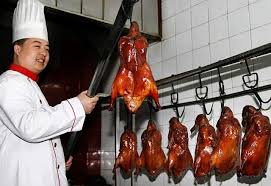
A saying is often heard that "there are two things you must do in Beijing, to eat the Beijing Roast duck and to see the ten thousands miles long Great wall." Hence, you must see that how essential a taste of the Beijing Roast Duck is in a Beijing tour. If you want to taste Beijing Roast Duck during your Beijing tour, Quan Ju De Restaurant, Jin Bai Wan Restaurant and Bianyifang Restaurant are good place for tasting.

Quan Ju De Restaurant


With a long history, Quan Ju De Restaurant was founded in the year of 1860, Qing Dynasty. There is no doubt that it is one of Bejing's oldest and most famous Beijing Duck eateries. There, the taste of Beijing Roast Duck is classic and everyone can enjoy. The duck offered in Quan Ju De Restaurant is handcrafted with knowledge passed down by generations of palace chefs, dating back to the Qing Dynasty.
The methods of roasting Beijing duck is hang the duck and roast it. The duck is cleaned, defeathered, cured and placed directly into the oven to roast.
If you want to taste the tradition Beijing Roast Duck, Quan Ju De Restaurant is the best choice for you. Average cost per person is about 100 RMB.

Bianyifang Restaurant


Founded in the 15th Century, the character of roast duck in Bianyifang Restaurant is crisp,fragrant and delicious. The method of roasting Beijing duck in Bianyifang Restaurant is braising the duck, in which the bird is cleaned, gutted and the duck is filled with a special stock. Bianyifang Roast Duck Restaurant has made its name by using this method.
Bianyifang makes full use of every part of the duck and creates dishes with their own special flavor, presenting a scrumptious duck feast for your eating pleasure. The price in Bianyifang Restaurant is cheaper than Quan Ju De Restaurant. In Bianyifang, average cost per person is about 80 RMB.

Jin Bai Wan Restaurant


Once voted best roast duck restaurant in numerous magazines in terms of overall, Jin Bai Wan Roast Duck Restaurant is a famous chain Beijng Restaurant with cooking the traditional duck and Chinese cuisine.
If you do not want to go to the restaurant, reservations in Jin Bai Wan Restaurant can be made over the phone, and delivery is available—those living nearby are just a phone call away from enjoying the delicious taste of old Beijing in their own home. The average cost in Jin Bai Wan Restaurant is more reasonable, just 50 RMB.

The notion of "Food is the first thing for people," is the most important and essential idea in Chinese Civilization Life. So you should not miss the Beijing Roast Duck during your Beijing tour.